
Service · Wesley Chapel, FL
Tree Cabling & Bracing in Wesley Chapel
Support systems for co-dominant trunks and heavy limbs on trees that are structurally weak but otherwise worth saving, backed by a two-year workmanship warranty.
Tree Cabling & Bracing Services in Wesley Chapel, FL
Not every structurally weak tree needs to come down. A co-dominant trunk — two roughly equal stems splitting from low on the tree — or a single heavy horizontal limb can be a real failure risk without the tree itself being unhealthy. Cabling and bracing physically supports that weak point instead of removing it, which is often the better option for a mature, otherwise-healthy tree that would take decades to replace.
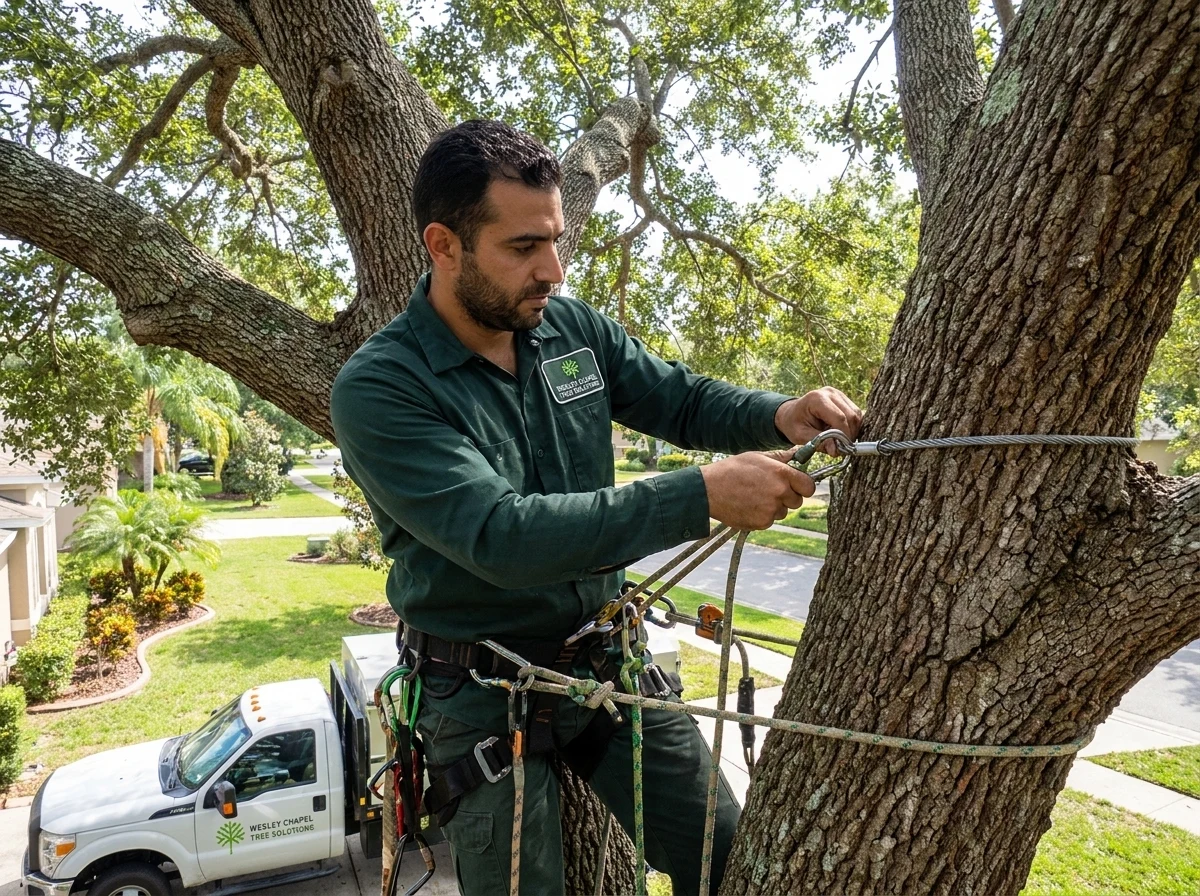
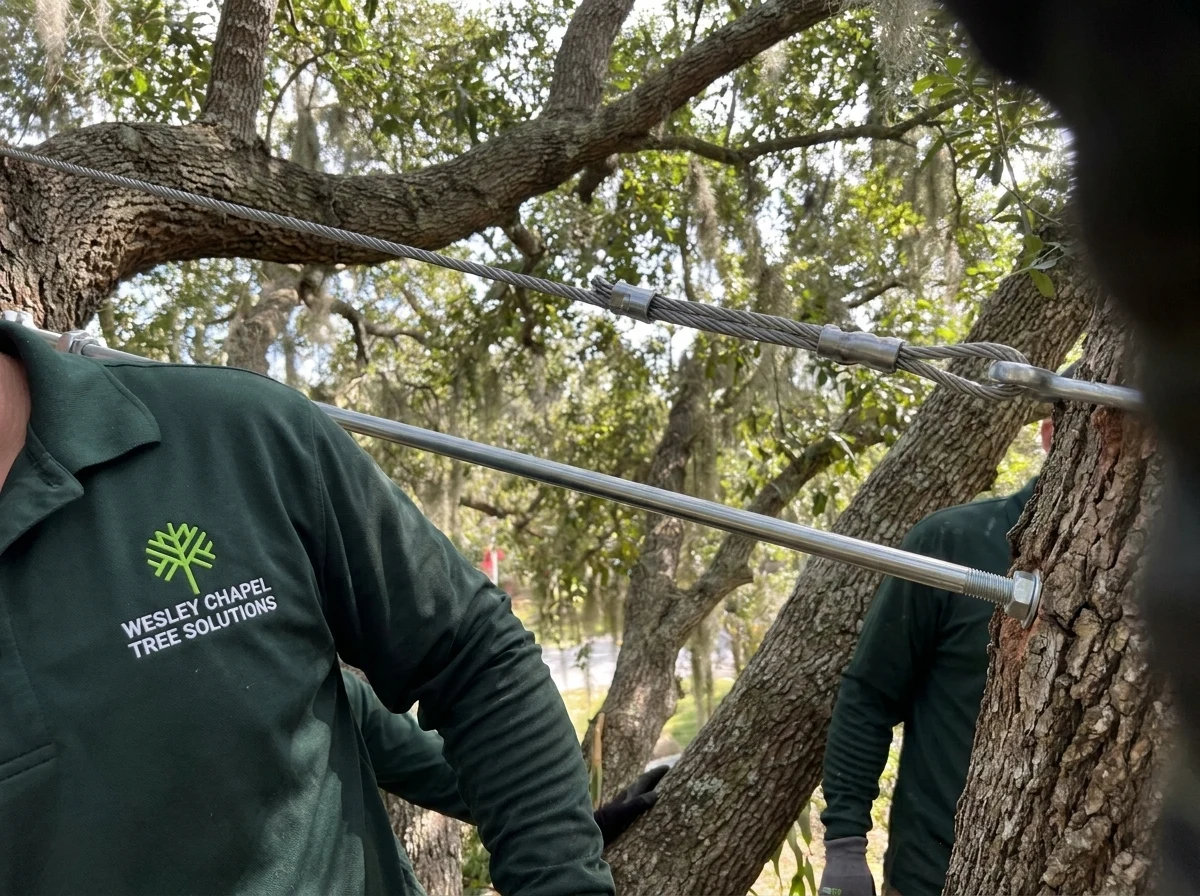
The two techniques do different jobs. Cabling installs a flexible steel cable high in the canopy between two major limbs or stems, limiting how far they can move independently in wind without restricting normal healthy sway. Bracing installs a rigid steel rod through a weak union lower on the trunk, physically holding the two sides together. Many jobs use both, chosen based on where exactly the weakness is and how the tree is loaded.
When cabling or bracing makes sense
- Co-dominant trunks — two main stems of similar size splitting from low on the tree, especially with included bark at the union.
- Heavy horizontal limbs — long, weighty limbs over a structure, driveway or gathering area that a storm could snap.
- Trees with prior storm damage — a limb or trunk that survived a break but is now structurally compromised.
- Historically or aesthetically significant trees — mature specimens worth the investment to preserve rather than remove.
- Trees flagged during a routine trim — structural weakness spotted while pruning that trimming alone can't fully address.
What cabling and bracing costs
A standard cabling installation, supporting one or two weak points in a mature tree's canopy, typically runs $300 to $900. Bracing rod installation, which requires drilling through the trunk at the union, runs $400 to $1,200 depending on the number of rods and access. Trees needing both cabling and bracing, or multiple support points, are priced per system rather than a flat per-tree rate.
| Job | Typical range | What moves the price |
|---|---|---|
| Single cable installation | $300 – $600 | Height, canopy access, number of anchor points |
| Multi-point cabling system | $600 – $900 | Larger canopy, multiple weak unions |
| Bracing rod, single union | $400 – $700 | Trunk diameter, drilling access |
| Combined cabling & bracing | $700 – $1,200 | Full structural support system |
| Follow-up inspection (within warranty) | No charge | Included in the 2-year workmanship warranty |
Why this beats removal for the right tree
A mature live oak on an established Wesley Chapel lot took decades to reach its current size, and a large canopy tree does real work — shade, curb appeal, and in many communities it's part of what a home was sold on. If the structural issue is isolated and the rest of the tree is sound, a $600 cabling job that buys another twenty years is a better outcome than a $1,800 removal, and we'll say so even though the removal pays more.
What cabling does not fix
Cabling and bracing address structural mechanics, not decay or disease. A tree with significant internal rot, active fungal infection at the base, or a root system compromised by construction or flooding isn't a good cabling candidate regardless of how the canopy looks — the support system is only as good as the wood it's anchored into. We'll tell you plainly when a tree has crossed from "needs support" to "needs to come down."
Inspection and follow-up
We recommend a visual check of cabling and bracing installations after any major storm, and periodically otherwise as the tree grows and the load on the hardware changes. That inspection is included at no charge within the two-year warranty window, and we're happy to do a courtesy check afterward too.
Where we do cabling and bracing work
Most common on the mature oak canopy around Wesley Chapel proper, Lutz and New Tampa, but available anywhere in our service area.
Questions
Tree Cabling & Bracing FAQs
A standard single-point cabling installation typically runs $300 to $600. Multi-point systems or trees needing both cabling and bracing run $600 to $1,200 depending on the number of support points and access. We quote a flat price on site after assessing the specific structural issue.
Properly installed hardware typically lasts many years, and we back workmanship specifically with a two-year warranty. The tree itself keeps growing around the anchor points, so periodic inspection — especially after major storms — is worth doing even after the warranty period, to confirm the hardware is still doing its job correctly.
Modern cabling systems use non-invasive or minimally invasive hardware designed not to constrict the tree as it grows. Bracing rods do require drilling through the trunk at the union point, which is a controlled, deliberate wound similar to what happens naturally at a branch break, and trees generally compartmentalize it well when installed correctly.
Look for a co-dominant trunk — two main stems of similar size — especially with a tight, V-shaped union rather than a wide U-shape, or a single heavy limb that seems disproportionately large for its attachment point. If the rest of the tree is healthy and the issue is structural rather than decay-based, cabling is usually the better and cheaper option than removal.
It significantly reduces the risk at the specific weak point being supported, but it isn't a guarantee against catastrophic storm damage — nothing is. What it does is limit how far the two sides of a weak union can move independently, which is what typically causes a co-dominant trunk to split apart under wind load.
Most mature hardwoods, including live oaks, are good cabling candidates. Palms are structurally different — a single trunk rather than multiple stems — and generally aren't cabled the same way; palm structural issues are usually a removal decision instead. We'll tell you during the estimate which category your tree falls into.
The workmanship warranty is tied to the property and the installation, not the original customer specifically, so a new owner can call us to honor a repair within the window. Keep your invoice or receipt as documentation of the installation date.
If a tree with cabling or bracing fails despite the support system — most often from a direct, severe storm impact rather than a workmanship issue — we treat it as a standard removal and quote accordingly. The support system reduces risk; it doesn't eliminate the possibility of failure in extreme conditions.
We recommend a visual check after any major storm and periodically otherwise, roughly every year or two, especially as the tree continues to grow around the hardware. That inspection is free within the two-year warranty window.
Both. Sometimes we spot a structural weak point while doing a routine trim and recommend cabling as a follow-up, and sometimes a homeowner calls specifically because they've noticed a lean or split starting. Either way, we'll show you exactly what we're seeing before recommending the work.
Somewhat, since bracing rods require drilling through the trunk at the union point, while cabling is typically installed higher in the canopy with less invasive hardware. Both are standard, well-established arboriculture techniques when done correctly, and which one (or both) your tree needs depends on where exactly the structural weakness is.
Related
Other tree work we do
Get a price for your tree cabling and bracing
Free on-site estimate with a flat written price before we start. Call or send photos and we will tell you what it costs.
Mon–Fri 7:00am–6:00pm, Sat 7:00am–3:00pm (24/7 emergency line for storm work) · Licensed & insured · Serving Wesley Chapel & Pasco and Hillsborough Counties