
Licensed & insured Free on-site estimates Same-week scheduling Pasco and Hillsborough Counties
Call 813-856-1229

Palms

How Often Should Palm Trees Be Trimmed in Florida?

Once or twice a year for most sabal and queen palms — removing dead fronds only. More frequent trims that remove green fronds weaken the crown rather than protecting it.

Palm trimming frequency is one of the more persistently over-corrected things in Florida landscaping. The instinct is that more trimming equals better maintenance, but palms don't work like hardwood trees — every green frond a palm carries is contributing stored energy it draws on later, and removing green fronds too often measurably weakens the tree rather than tidying it up.

The general rule

Once or twice a year for most sabal and queen palms — the two most common species in Wesley Chapel-area landscaping — removing only fronds that are brown, clearly dying, or hanging below roughly the nine and three o'clock position relative to the trunk. Healthy green fronds above that line should stay regardless of how the palm looks compared to a more aggressively trimmed neighbor.

Frequency by species
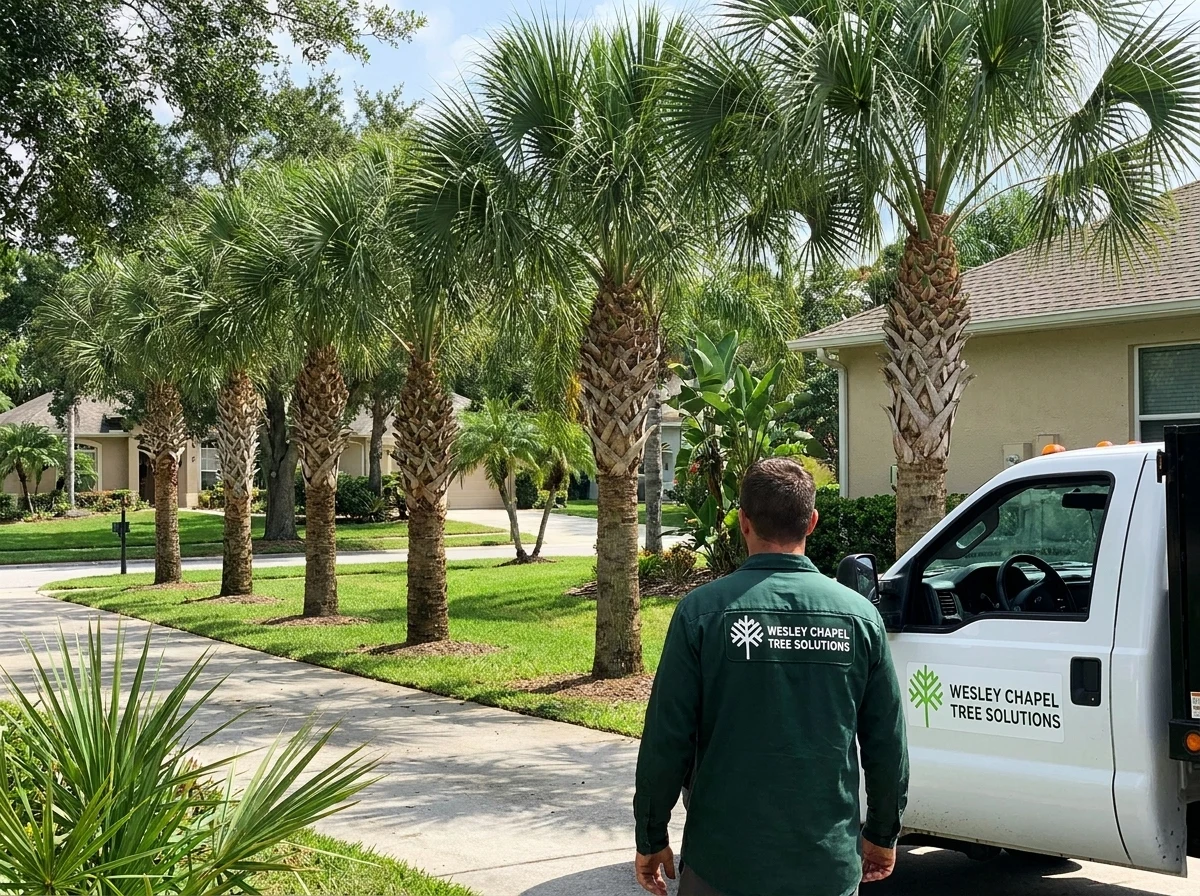
Properly trimmed sabal palm with only dead fronds removed in Wesley Chapel
ItemDetail
Sabal palm (Florida state tree)1–2x per year, dead fronds only
Queen palm1–2x per year, dead fronds only
Canary Island date palm1x per year typically, different boot-retention pattern
Pygmy date palmAs needed, generally light and infrequent

Why over-trimming actually hurts the palm

A palm's trunk doesn't add new wood the way a hardwood's does — its structural growth happens entirely through the crown. Every frond removed while still green is stored energy the palm doesn't get back, and over-trimmed palms show measurably thinner, more stressed crowns over time compared to conservatively trimmed ones. It also leaves the palm more vulnerable to pests like palm weevils, which target stressed trees preferentially.

The "hurricane cut" myth

A true hurricane cut — trimming a palm down to a small tuft of remaining fronds before a storm — is based on the idea that fewer fronds means less wind resistance and less damage. It doesn't meaningfully reduce storm damage, because palm crowns are naturally aerodynamic and flex with wind rather than catching it the way a broad hardwood canopy does. What it does do is remove fronds the palm needs for energy production, leaving it visibly weaker and slower to recover. See our hurricane season tree prep guide for what actually helps ahead of a storm.
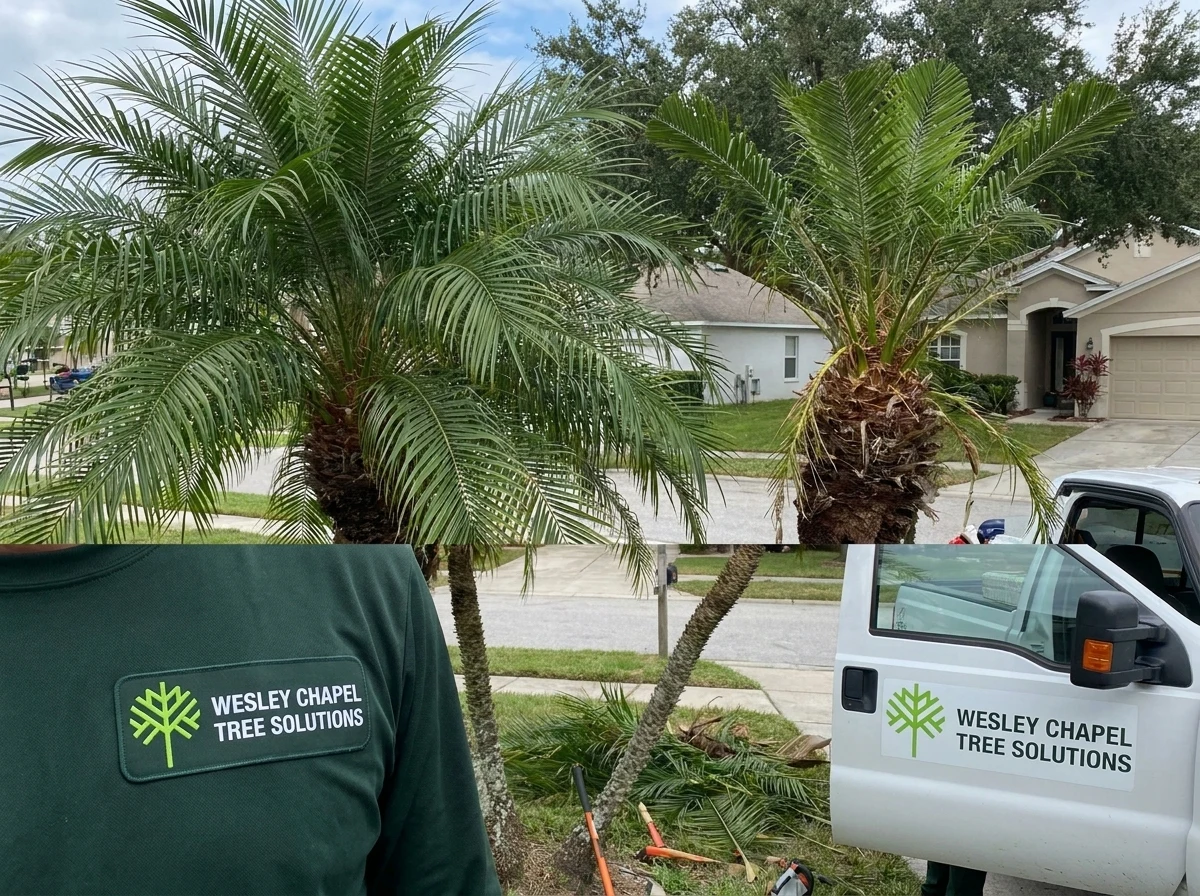
Comparison of a properly trimmed palm crown versus an over-trimmed palm crown
Landscaping crews often over-trim by defaultQuarterly "clean-up" visits that strip a palm down to a bare pineapple look tidy and are quick work for a landscaping crew, but they're not what the palm needs. If your palms have been on a quarterly trim schedule, switching to once or twice a year with a more conservative cut usually produces a visibly healthier crown within a year or two.

Signs your palm has been over-trimmed

  • A visibly thin, sparse crown compared to how a healthy specimen of that species should look.
  • Slower growth and fewer new fronds emerging than in previous seasons.
  • A "pineapple" silhouette — trunk exposed with only a small tuft of fronds remaining at the top.
  • Increased vulnerability to pests like palm weevils, which preferentially target stressed palms.

When a palm needs more than trimming

Some palm problems aren't a trimming issue at all. Ganoderma butt rot, identifiable by a shelf-like fungal growth at the trunk base, is fatal and untreatable once established, and a confirmed case needs removal before the trunk becomes a fall hazard. See our palm tree trimming page for what we check on every visit, and our tree removal page if a palm has crossed that line.

Need this looked at? Free on-site estimate anywhere in our service area, with a flat written price before we start. Call 813-856-1229 or request a quote.

Questions

Related questions

Once or twice a year, removing only dead and clearly declining fronds. Sabal palms — Florida's state tree — are especially sensitive to over-trimming, since their crown becomes more vulnerable to boring insects once stressed.

Yes, significantly. Removing healthy green fronds takes stored energy the palm cannot recover, stresses the crown, and leaves it more vulnerable to pests. Over-trimmed palms show visibly thinner crowns over time compared to ones trimmed conservatively once or twice a year.

No — a true hurricane cut doesn't meaningfully reduce wind damage, since palm crowns are naturally aerodynamic, and it removes fronds the palm needs for energy. We don't perform them and can explain the reasoning if you've been told otherwise.

Fronds that are brown, clearly dying, or hanging below roughly the nine or three o'clock position relative to the trunk are appropriate to remove. Healthy green fronds above that line should generally stay, even if it makes the crown look fuller than a neighbor's more aggressively trimmed palm.

No — sabal and queen palms do well on a once-or-twice-yearly schedule removing only dead fronds, while species like Canary Island date palms have different boot-retention patterns and are typically trimmed slightly differently. We assess each species individually.

Often, yes, if "every visit" means monthly or quarterly landscaping stops. Routine lawn crews sometimes default to trimming palms on the same schedule as mowing, which is considerably more frequent than palms actually need and can lead to over-trimming over time.

Generally yes, given time and a more conservative trimming approach going forward. A visibly stressed, thin crown from a history of over-trimming typically improves over a year or two once green fronds are allowed to remain longer between visits.

Ganoderma is a fungal disease that decays the trunk base from the inside, identifiable by a shelf-like conk that eventually appears — it's a different and more serious issue than trimming-related stress, is untreatable, and requires removal once confirmed.

Not dramatically — palms grow relatively steadily year-round in Florida's climate compared to seasonal hardwood dormancy, so the once-or-twice-yearly interval applies fairly consistently rather than concentrating around a specific season.

There isn't really a one-time "fix" — it's more about switching to a more conservative trimming schedule and letting the crown rebuild naturally over time. Standard trimming visits run $75 to $250 per palm depending on height, the same as any other trim.

Get your tree taken down right

Free on-site estimate, flat written price, and a crew that does nothing but trees. Tell us what needs to come down and we'll tell you what it costs.

Mon–Fri 7:00am–6:00pm, Sat 7:00am–3:00pm (24/7 emergency line for storm work) · Licensed & insured · Serving Wesley Chapel & Pasco and Hillsborough Counties

Tap to call Free quote